Sony Xperia Z5 review

Introduction

With the Xperia Z5 family, Sony has definitely piqued the interest of the public, delivering not one, but three flagship devices. The Z5 Premium is the world first 4K screen phone, while the Xperia Z5 compact is a powerhouse device with a small footprint.
This, however, puts the regular Z5 in somewhat of an odd spot. For the first time ever, the standard "Z" model is not the "latest and greatest" Sony has to offer. It also almost identical to the Z3+, while being quite a bit more expensive.
But reading the specs on paper really doesn't reveal the extent in which To really see the Z5 for what it is and understand all the work Sony has put into making it a familiar, yet refined device, we have to dig deeper. That is just what we intend to do in the following pages - to see just how different the Z5 is from the Z3+, what has changed and what has been preserved. To discover if the Z5 is Sony's flagship savior, or just a fixed-up Z3+, bound to stay underappreciated amidst its superstar siblings.

Key features

  • 5.2" 16M-color 1080 x 1920 IPS LCD capacitive touchscreen with X Reality for Mobile, Triluminos technology and Dynamic Contrast Enhancer; scratch-resistant glass, oleophobic coating
  • Android OS v5.1.1 Lollipop with Xperia launcher
  • Octa-core Qualcomm MSM8994 Snapdragon 810, feat. a quad-core 1.5 GHz Cortex-A53 and quad-core 2 GHz Cortex-A57 and an Adreno 430 GPU and 3GB RAM
  • 23 MP camera with 2160p@30fps video recording; 5.1 MP front-facing camera with 1080p@30fps video
  • 32GB of built-in storage and a microSD card slot
  • LTE Cat.4 (150Mbps)/Cat.6 (300Mbps), depending on the region; Dual-band Wi-Fi a/b/g/n/ac; A-GPS/GLONASS receiver, Bluetooth v4.1, FM radio with RDS
  • Active noise cancellation with a dedicated mic
  • 2,900mAh non-removable battery
  • IP68 certified - dust and water proof up to 1.5 meter and 30 minutes
  • Fingerprint sensor

Main disadvantages

  • Screen bezels are wider than the Xperia Z3+
  • Non-removable battery
  • Heavier and thicker than the Xperia Z3+
It is quite obvious that specs-wise the Sony Xperia Z5 does not disappoint. The handset is powered by Qualcomm's top-of-the-line Qualcomm MSM8994 Snapdragon 810 chip, along with an Adreno 430 GPU, 3GB of RAM and 32GB of onboard storage. That also happens to be the case with the Z3+. Similarities extend even further to the 5.2-inch FullHD display that also seems to be shared between the two models. In fact, the only significant hardware differences between the pair are the fingerprint reader and the camera.
Sony is betting big on its new multi-aspect 23MP sensor, which is being marketed as the Z5's major feature. However, the same shooter is actually present in the Z5 Compact and Z5 Premium as well, so it is not quite as exclusive to the model as Sony would have you believe. It's nonetheless an excellent camera and we can't wait to put it to use.
But let's not get ahead of ourselves. The most important thing is that the Z5 Compact promises to learn from the Z3+ and its mistakes and excel where it failed. That's alone is enough to warrant a full length review. So jump on.
U Watch U8 SmartWatch Review

U Watch U8 SmartWatch Review

  • U8 SmartWatch Review
  • Rating:3
  • SmartWatch: U Watch
  • Price: $32.11 on gearbest
  • Reviewed by: 

Review Summary:

Everyone is coming out with SmartWatches, but the prices usually are not so smart. Check out U Watch's SmartWatch with the smartest price ever.
So what do you do when you are out of time and need to get your life in order?  Makes sense to get a smart watch, but what can they do and what can they do for you?  Stop asking so many questions and check out my review of the U8 SmartWatch.
Includes:
  • SmartWatch
  • USB Cable
  • Manual
  • Dismounting/Assembly Tool for the watchband
  • Wall Charger
A very nice looking interface, but alas, it was not meant to be.  Please remember, unlike the iPhone (which does work with this watch as well) there are tons of different Android OS versions, watch/tablet configurations/manufacturers so it is harder for U8 to write software for all these variants so even if the software did not work for my phone, that does not mean it will not work for yours.
I will reiterate that there are tons of different pieces of software written to interact with smartphones and smartwatches, the fact that this will allow you to use them makes this such a great watch.
Pros
  • Allows you to Make or Receive phone calls
    • Through the phone book
    • Or manually through the dialer
  • Allows you to listen to music from your phone through it (MP3’s or Streaming audio)
  • Works as a Stop Watch
  • Works as an Altimeter
  • Works as a Barometer
  • Works as a Pedometer
  • Works as a StopWatch
  • Can change Ringtones
  • Can take pictures/videos through it from your phone
  • Digital or Analog Watch interface
  • Notifies you of incoming Email
  • Notifies you of incoming Facebook/Twitter messages
  • Allows you to use multiple pieces of software suites to communicate through it
  • Amazingly low price
  • Works through Bluetooth V3.0 EDR or better.
Cons
  • Short battery life
  • Software to install onto your Android device does not work well (with my phone)
Our friends at Gearbest provided this watch for me to review and I thank them very much.  They also tried to help me get the software to work through my phone, although with all of our efforts, it just would not.  After I would try to set my height or my birthdate the software would just crash on my phone, and keep causing errors, even if it was not loaded.  Once I uninstalled that software and installed KHR1.3.2.2 it worked properly.
So this leads us back to my initial question,  what makes this one so different than its much more expensive counterparts?  Well the simple answer is nothing, it does everything its much more expensive cousin’s do at a much more affordable price. saving you money to buy other gear you like or maybe to pay off a bill or 2, makes sense to me.
I would love to give this watch a 5, but because of the battery life and software issues, I will have to give it a 3.5.  I would have been a 3 or a 2.5 if the price wasn’t so great but it is amazing.  A great starter watch to introduce you into the world of SmartWatches and maybe even something you stick to.
Oppo N1 review

Oppo N1 review


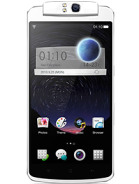
Announced in October, the Oppo N1 isn't your typical smartphone. For one, it's huge -- the 5.9-inch full-HD display takes up most of the space, and it comes with something you seldom see in a smartphone: a rotating 13-megapixel camera that you can flip over to take a selfie.

Design

Packing the aforementioned large display, the Oppo N1's shape reminds me of the Samsung Galaxy  Nexus, though the handset lacks its slightly curved display, thanks to its curved edges. And while the N1 looks like it has an edge-to-edge display like the LG G2, it's actually not the case, as you can see in our picture below.
Screenwise, I have no complaints about the 5.9-inch full-HD IPS screen of the N1. Colors were vivid and there were no color shift issues even when using the phone at awkward angles (which you normally won't). The only concern I have is that the large size of the handset doesn't really fit into your pocket all that well at times. (I had to take it out of the front pocket of my jeans when sitting down or it feels really uncomfortable.)

Features

The Oppo N1 uses a custom operating system called Color OS that's based on Android 4.2 (Jelly Bean). Interestingly, the UI looks very similar to Xiaomi's MIUI, especially the buttons and fonts. Color OS generally handles very much like your standard Android smartphone, and there are some software tweaks such as an image enhancer that adds makeup to your selfies, as well as a theme app (like MIUI) that lets you reskin the OS to your liking.
There's also a gesture feature that's activated by swiping down from the top-left corner much in the way that you would bring down the drop-down notification menu. You can then quickly use your thumb to draw a pattern that can be set to do a whole array of things, like launching the camera, a flashlight, or an app. I found that simple gestures are the easiest to do; make it too complicated and you'll have issues trying to repeat it.
Samsung Galaxy S7 Edge review

Samsung Galaxy S7 Edge review

The Samsung Galaxy S7 Edge is a phone I'd hate to have had to make. Its predecessor was a multi-award-winning phone, simply because it packed all the power of the 'normal' Galaxy S6 and yet... that curved edge. I wasn't alone in loving it, whipping it out proudly whenever possible.
But that was last year, and the world is bored of the curved design. We've seen it. It's been done. So what can Samsung do to make the new phone a real step forward?
Well, unlike what it's done on the Galaxy S7 The screen is larger, yet somehow the phone doesn't feel too much bigger in the hand. The rear of the phone is now curved too, making it sit nicely in the hand. It's waterproof. There's a microSD card slot. There's so much power in there I'm pretty sure I could strap it on the back of a speedboat and make my way across the Atlantic.

And that's even more possible because the battery – such a disappointment on last year's S6 phones – is boosted massively too, giving us a handset that's able to last over 24 hours between charges.
All this comes at a cost obviously, and a pretty hefty one. In the UK that cost is £640, while in the US you're looking at a huge $299 on contract. In Australia, the Galaxy S7 Edge attracts the highest price for a Galaxy yet: AU$1,249 for the 32GB version.
That's quite a jump from last year's AU$1,149 starting price, showing this is one of the most expensive phones around.
But, in my view, it's worth every penny.

Design

The Galaxy S7 Edge is a phone that lives and dies by its looks. If you're only interested in the power then just go for the standard Galaxy S7. The smaller, 'normal', model has got all the same smarts, but a slightly sharper screen thanks to packing the same amount of pixels into a smaller area.
What it misses is the clever elements that Samsung's used on the Edge. The display curves further away into the sides of the phone than ever before, which means that even though you've got a phablet-sized display, the phone is as compact as possible.
Place it side by side with the iPhone 6S Plus and you'll see what I mean. The amount of bezel used above and below the display on Apple's phone is almost laughable, especially when you compare it to how tightly packed everything is on the S7 Edge – and the Samsung has a much, much larger battery.

Screen

The display, while technically part of the Galaxy S7 Edge's design, is worthy of chatting about in its own right – simply because it looks so great.
It's the defining feature when you pull this phone out among friends, and while it doesn't elicit the same response that the S6 Edge's display did last year (like I said, curved displays are nothing new these days), it still gets a lot of approving looks, especially as it's combined with the rounded back.

The QHD resolution of 2,560 x 1,440 still looks as good as anything I've seen on a smartphone. Despite being stretched a little from last year, the 5.5-inch size still looks absolutely pin-sharp, and it's very hard to see any artefacts lying around on the screen.
It's amazing to think that, two years after LG brought out the first mainstream QHD phone, we still don't have any dedicated content that can be viewed at this resolution. Despite that, however, I don't feel like the Galaxy S7 Edge really suffers, as that display makes viewing web pages and photos a really great experience.
The S7 Edge uses Super AMOLED technology, which Samsung's been chucking out for close to a decade now, and it really works well to make the phone look premium and the colors really pop.
The contrast ratio – the difference between the whitest whites and the blackest blacks – is still pretty sensational, which is because when they're not in use, the pixels are turned off; with something like the iPhone 6S or the LG G5 you've got a display that just blocks out the backlight when the pixel is showing a black image, so there can be a small amount of light bleed-through.
The Galaxy S7 Edge screen also has the added benefit of the side display, which is accessed by swiping your thumb along from the right- or left-hand side of the phone's screen (you can specify which in the settings).
Where this was a nonsense, useless feature in years gone by, the side display has a much more defined role on the Galaxy S7 Edge. You can easily get access to news, regular contacts, tools (the ruler, for digi-measuring is back – GET IN) and other elements that are currently in development.
Check out the Specs and Performance section of this review to hear a little bit more about this feature – or skip it entirely if you're bored of hearing me witter on about a piece of the display you can swipe.
The iPhone SE Review

The iPhone SE Review

With the launch of the iPhone 6, Apple had finally tapped into the latent demand for bigger iPhones, and as a result we saw some record-setting quarters from Apple. However, at the same time by moving to a larger display size there was a fairly sizeable audience that was being left behind. While a 4.7" phone is generally a one-handed device for most, there's definitely a sizeable portion of iPhone users that bought the iPhone 5s because the 4-inch size was the largest they could go without facing problems with one-handed usability.
The other challenge that Apple faced was their need to be more competitive at the mid-range. For a lot of people, 300-400 USD is pretty much the most that they can afford to pay for a smartphone, and as a result the value proposition for an iPhone flagship that was two generations behind the latest was increasingly weak in markets like India and China, especially when Xiaomi and Huawei were often shipping the latest and greatest hardware for similar prices. While margin might not be as high in this segment of the market, the volume here can definitely compensate.
With these two issues in mind, this brings us to Apple's newest iPhone, the iPhone SE. As Apple's smaller iPhone, the iPhone SE has two functions. It provides a viable option for users who want a smaller iPhone, and it allows Apple to sell at price points that they can't reach with their larger and more expensive iPhones. This is especially key with Apple's push to increase sales in emerging markets like China and India, as for many people the price of the iPhone 6s and 6s Plus makes them inaccessible. As you'll see, the iPhone SE brings the price of a new iPhone lower than it has ever been before.
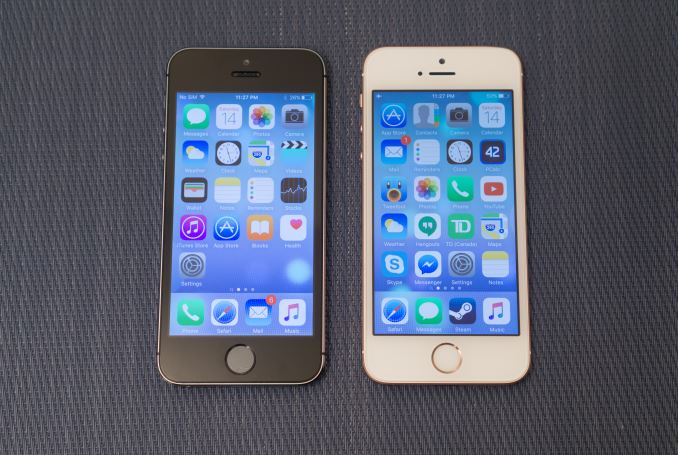
It's probably no surprise at this point, but the iPhone SE is going to be a familiar phone. With essentially the same chassis as the iPhone 5s, the iPhone SE marks the first time that Apple has used the same design in three generations of an iPhone. While the iPhone SE is the same as the iPhone 5s on the outside, Apple has made some serious improvements to what's on the inside. Below you can see how Apple's new 4-inch smartphone compares to its predecessor, and to Apple's flagship iPhone, the iPhone 6s.
Apple iPhone Line
 Apple iPhone 5sApple iPhone SEApple iPhone 6s
SoCApple A7
2 x 1.3GHz Apple Cyclone
Apple A9
2 x 1.85GHz Apple Twister
GPUPowerVR GX6450PowerVR GT7600
RAM1GB LPDDR32GB LPDDR4
Display4.0-inch 1136 x 640
IPS LCD
4.7-inch 1334 x 750
IPS LCD
Size / Mass123.8 x 58.6 x 7.6 mm
112 grams
123.8 x 58.6 x 7.6 mm
113 grams
138.3 x 67.1 x 7.1 mm
143 grams
CameraRear Facing
8MP iSight with 1.5µm pixels + True Tone Flash
Rear Facing 12MP iSight with 1.22µm pixels
+ True Tone Flash
Front Facing
1.2MP f/2.4
Front Facing 5MP f/2.2 + Retina Flash
Storage16GB
32GB
64GB
16GB
64GB
16GB
64GB
128GB
I/OApple Lightning connector, 3.5mm headset
WiFi2.4/5GHz Dual Band
1x1 802.11n 
BT 4.2
2.4/5GHz Dual Band
1x1 802.11ac
BT 4.2, NFC
2.4/5GHz Dual Band
2x2 802.11ac
BT 4.2, NFC
Price16GB: $44916GB: $399
64GB: $499
16GB: $649
64GB: $749
128GB: $849
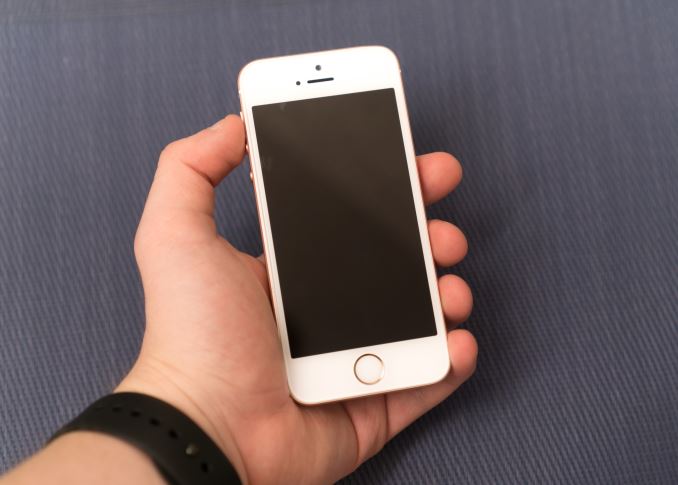
Even if I hadn’t put any images on this page, it’s likely that you’d be able to visualize the design of the iPhone SE. At its core it’s a design that has been around since 2012, with a few tweaks having been made along the way. Despite that, it’s a design that still holds up, and I think the HTC One M7 is the only other device from that time that you can really say that about today.
From an aesthetic point of view, the chassis style of the iPhone 5, 5s, and SE is still one of my favorite smartphone designs. The flat sides, chamfered edges, circular volume buttons, and antenna inserts all make for an elegant look, and in my opinion it’s actually a more visually appealing design than that of the iPhone 6/6s which uses injected plastic antenna lines, chiclet buttons, and a camera hump. On the flip side, the iPhone 6 definitely comes ahead as far as ergonomics are concerned. The flat sides and chamfered edges of the SE make for an elegant design, but when you make a phone with flat edges on all sides you inevitably end up with a somewhat brick-like device that doesn’t conform well to the human hand. The fact that the iPhones with this design have all had displays of 3.5” or 4” lets them get away with this due to their smaller profile, but there’s no denying that the curved iPhone 6 design has a better in-hand feel.
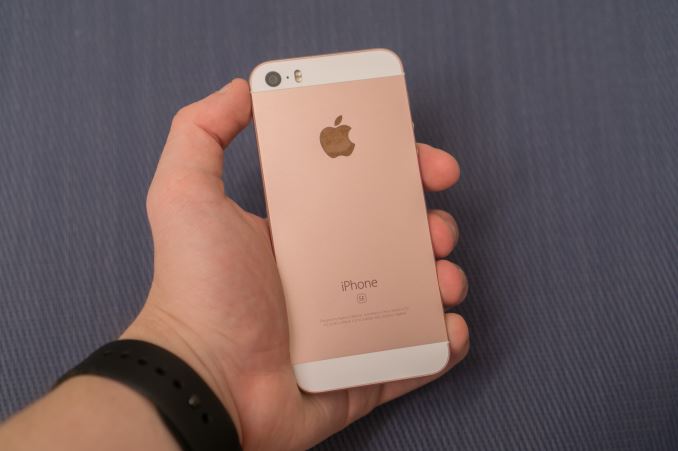
Almost nothing has changed externally going from the iPhone 5s to the SE. The dimensions are unchanged, and the mass has only gone up by a single gram. I've only noticed two changes. The first is the elimination of the regulatory logos from the rear of the chassis, and the second is a change from a shiny chamfered edge to one with a matte finish that matches the rest of the chassis. Beyond that, and the inclusion of the new rose gold color, the design is unchanged from the iPhone 5s.
Going with an older design has some advantages and drawbacks, and some of these end up being the same aspect viewed from two different perspectives. For example, with the SE being a less expensive iPhone in an older design, Apple isn’t pushed to make it the thinnest possible device. While this is arguably a bad thing by Apple’s own standards, it does mean that there’s more space for the battery than if Apple were to slim down the device, and you don’t get a camera hump. The older design does come with a fairly large bezel on the left and right sides of the screen relative to the size of the display itself, and the black space between the white face plate and the actual screen is significantly thicker than on newer iPhones which does make the design look a bit dated.
The iPhone SE may be part of a larger general trend where smartphone designs don’t change as significantly from generation to generation now that the market is maturing. In many ways, having to change your design every year is actually not a good thing, as it implies that your past design had significant flaws that necessitated a brand new one. Samsung’s Galaxy S7 is a good example of this, with the design changes being minimal but noticeable refinements on the existing Galaxy S6 which had a much better design than its predecessors. Good design is long-lasting, and much like how the truly good laptops on the market can keep the same design for many years, smartphones will likely begin to do so as well, with smaller refinements to accommodate new features, and in Apple’s case, a continued reduction in device thickness.
Ultimately, the design of the iPhone 5 and 5s still works, and there aren’t any significant flaws with it that would necessitate a change in design. With it being a well-known and, as Apple puts it, beloved design, it’s not surprising to see it return for a third time in the iPhone SE. While there are some small tweaks like changing the chamfered edge from a reflective to a matte finish, the core design is the same one that Apple’s existing owners of 4” iPhones know and love.